Evidence lives in emails, spreadsheets and shared folders.
Every control, document and result stays attached to the batch that gives it meaning.
Releasing sooner and controlling more stop competing once controls, evidence, specifications and owners live in the same batch record. Every batch moves with the grounds for it in plain sight.
Nothing to install · five guided tours · fictitious data
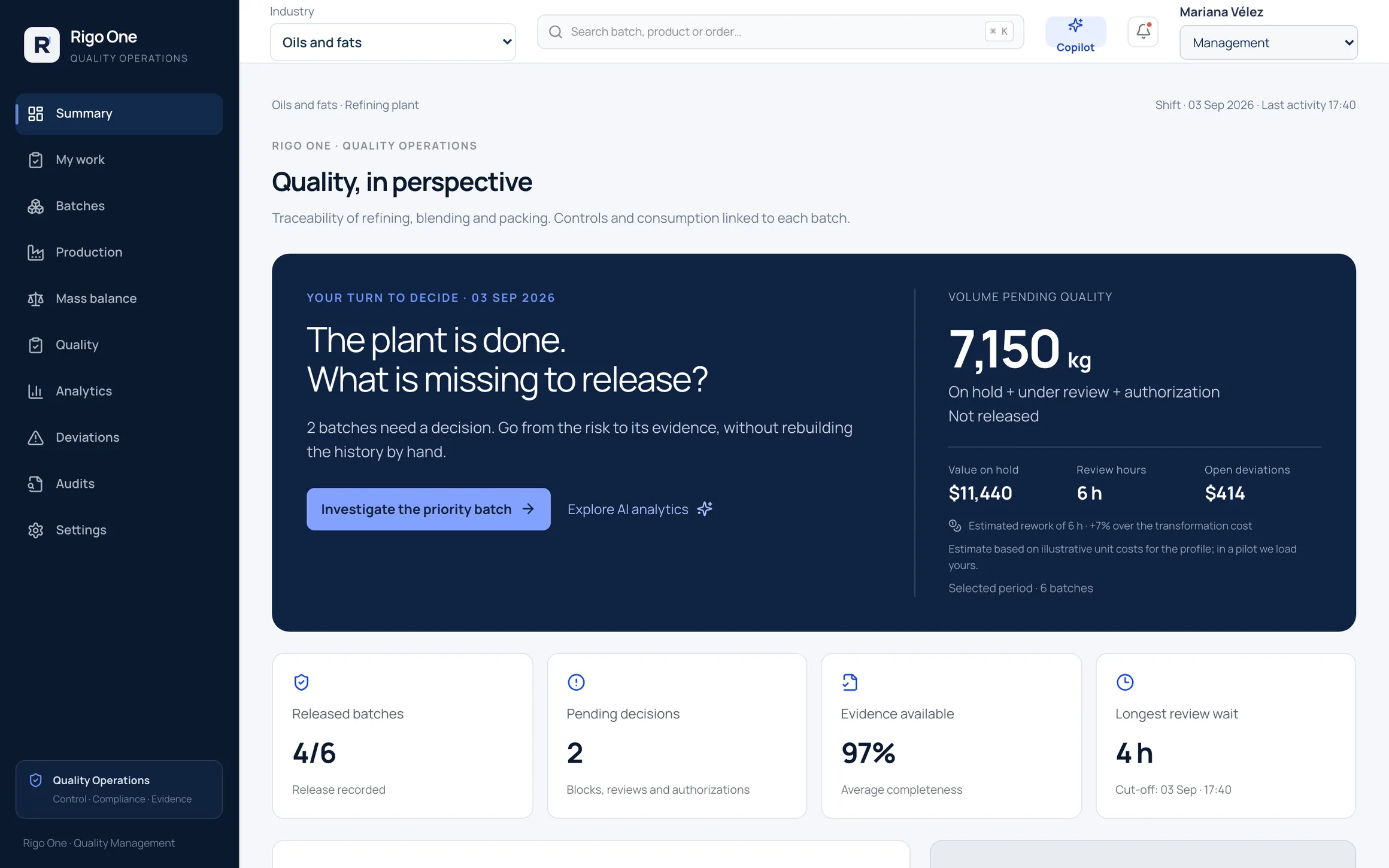
Real screens from the demo · Oils and fats profile · fictitious data
Speed.
Control.
Evidence.
THE STARTING POINT
When an audit asks about a batch, or a shipment is held, the answer is usually scattered across systems and people.
Evidence lives in emails, spreadsheets and shared folders.
Every control, document and result stays attached to the batch that gives it meaning.
Nobody knows for certain whose turn the next step is.
Every open item has an owner, and every person sees their next action.
A batch is released with no record of why it was decided that way.
The decision keeps who acted, what they verified and on what grounds.
FROM DATA TO DECISION
Rigo One is a quality management and traceability software for batch-based industrial operations. It brings controls, documents, specifications, results and owners together in a single batch record, so that releasing sooner and controlling more stop competing: evidence review and the release decision happen in one place, with the grounds on record.
Controls, documents and results connected to the batch that gives them meaning.
Prepare, review, correct and authorize. Everyone finds their next action.
A history that keeps who acted, what they verified and why they decided.
WHAT IT INCLUDES
They come included by default, not as add-on modules. Each one answers a concrete question from the shop floor; together they keep a single version of the facts.
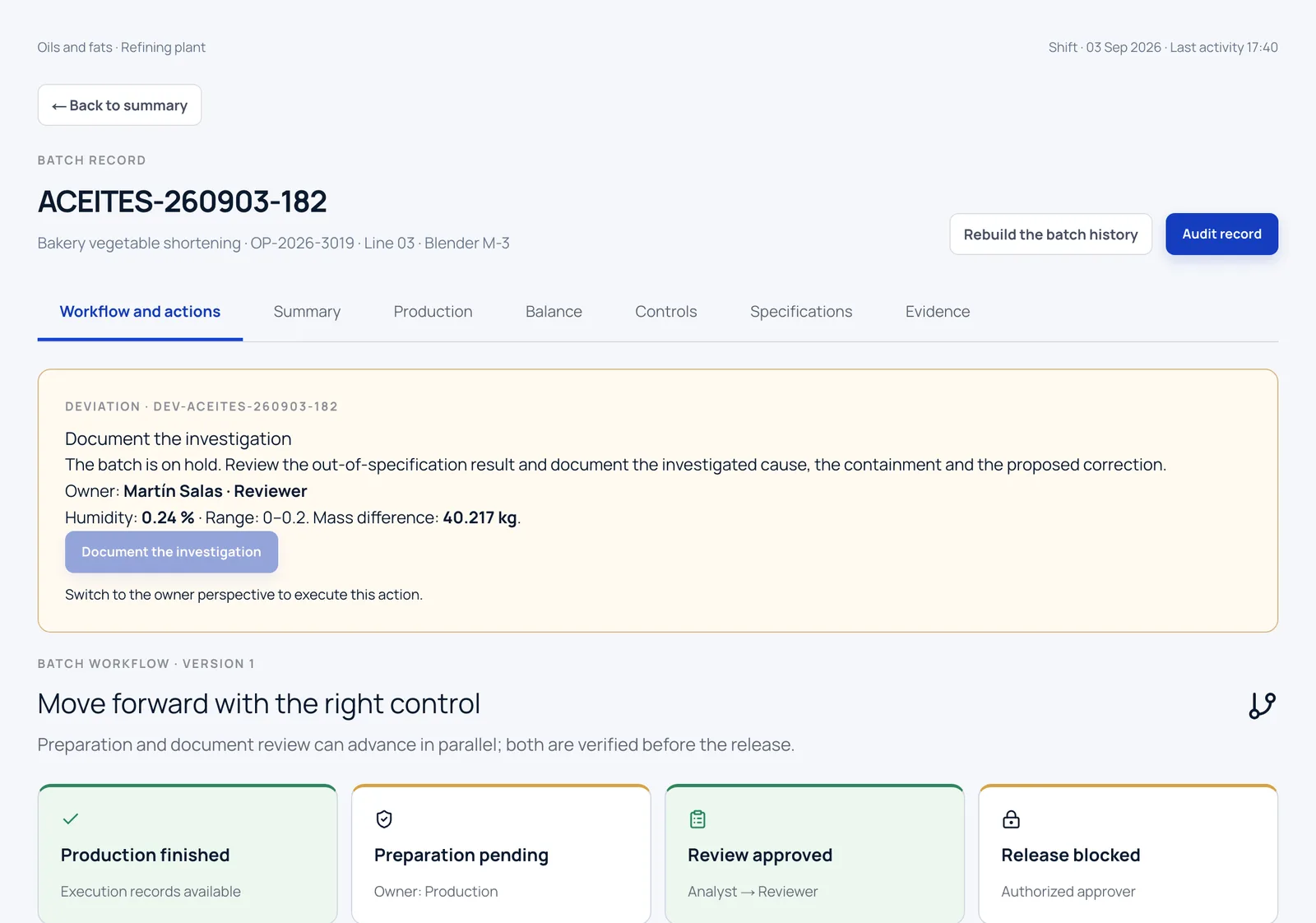
Origin, stages, controls, documents, incidents and decision brought together in one place, with their status always visible.
Which raw materials went into the batch, and which other batches used them. The scope of an incident stops being guesswork.
Every result is compared with its range. An out-of-specification value blocks the release, even when the batch record is complete.
The same batch can conform for one customer and not for another. Every specification keeps its dated versions with the reason for the change, and accepted concessions sit in a catalogue with reference and validity.
Investigation, containment, correction and verification as distinct steps. Closing a deviation (nonconformity) does not authorize the release.
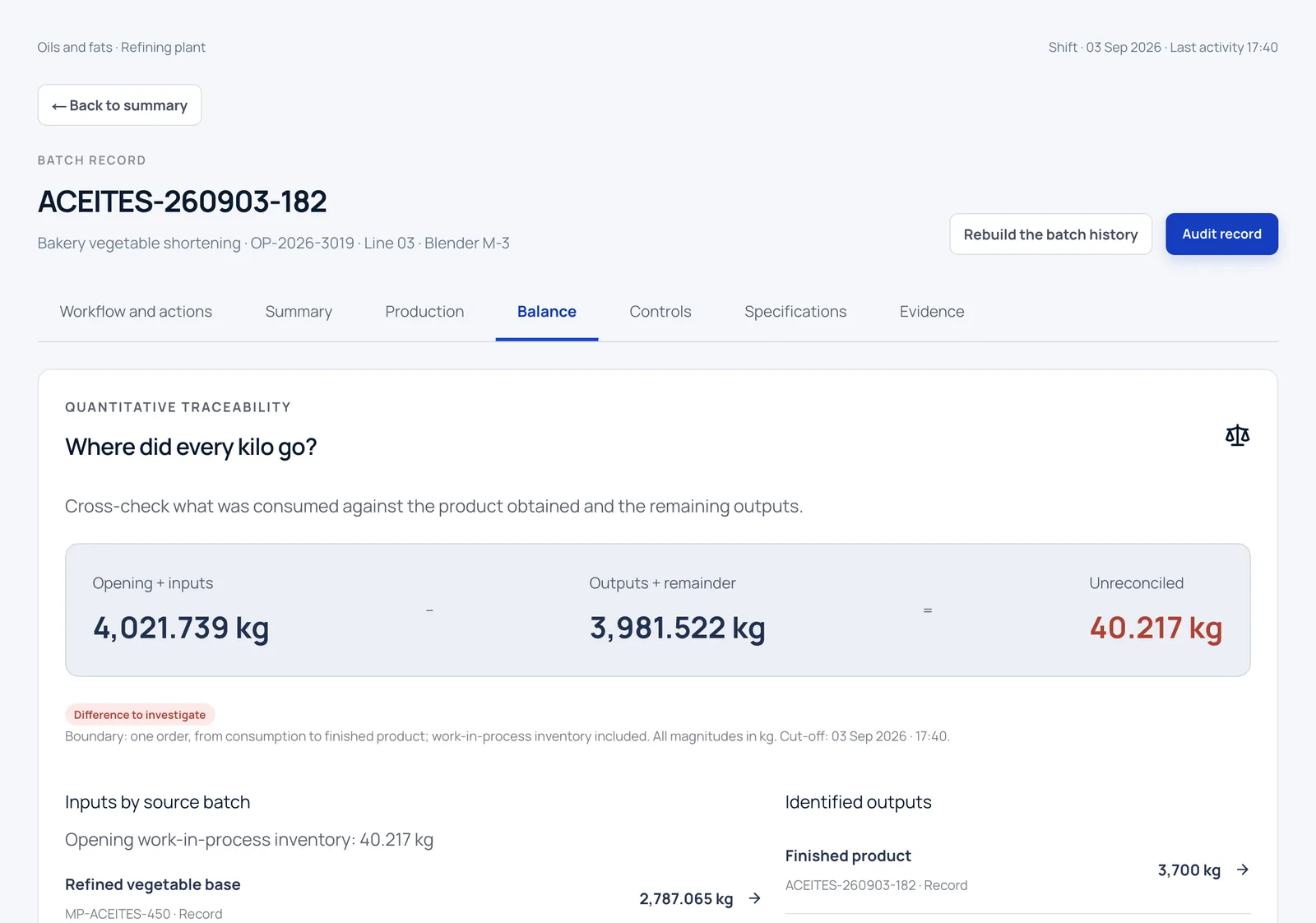
Opening inventory plus inputs, minus outputs and closing inventory. It tells recorded figures from estimated ones and keeps the difference instead of assigning it to process loss by default.
Filters by product, line and control, comparison between lines and export. Every figure lets you open the batch behind it.
Ask in plain language for the batches with a given raw material, piece of equipment or line, or with a parameter above a threshold. Every answer arrives with the batches that support it, one click away; the decision stays with the person.
The conditions of the run —temperature, pressure, time, cold chain— are captured by stage during production, with time and owner. They explain how the batch was run; the release is still decided by the laboratory controls.
Prepare, submit, review, correct and authorize are separate transitions, each one with author, time, rationale and the version of the workflow configuration.
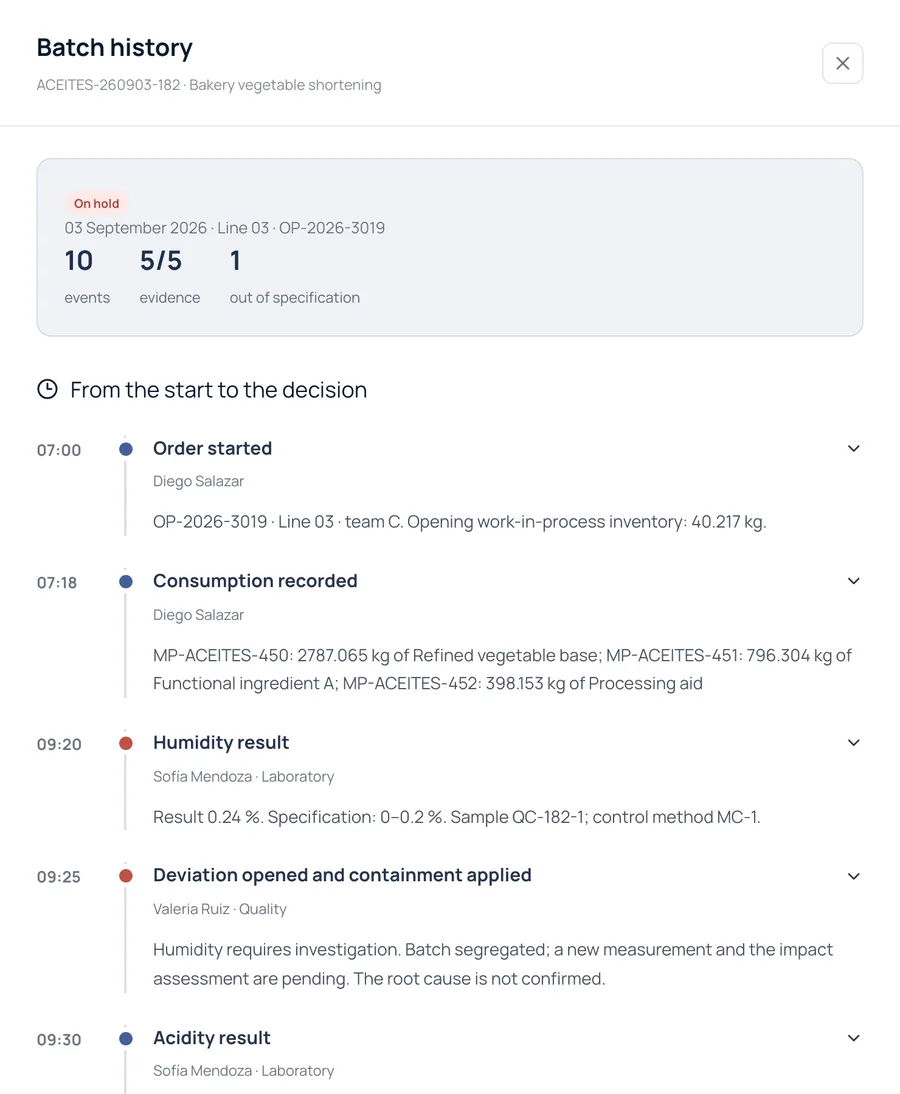
Production, history, balance and decision in a single file that reproduces the structure of an audit batch record for an internal or external review.
WHAT CHANGES, IN NUMBERS
These are the ranges we project once evidence stops being chased. They are not promises: they are the success criteria set plant by plant during the discovery and checked in the closing report of the pilot.
The complete batch record and the decision with its grounds sit in one place, so deciding no longer waits for someone to gather the evidence.
What is on hold stops waiting for a figure to surface: every batch shows what is missing and who has to resolve it. Measured as average value on hold per week.
Review concentrates on what is out of specification or incomplete, instead of walking through the whole batch record. Measured in hours spent per released batch.
Rework, rejections and concessions are quantified by batch and by cause, so the most expensive one is tackled first. Measured as a share of conversion cost.
These are conservative estimates, not guaranteed results. The baseline figures for each indicator are taken from your own operation during the discovery, together with the success criteria, and compared against the same measurements when the pilot closes. See how it is evaluated.
BATCH RECORD
Origin, stages, controls with their range, documents, incidents and the decision workflow. The batch status explains itself: what conforms, what is missing and who must act.
BATCH HISTORY
Every event keeps its time, owner, reference and outcome: from the order started to the release decision. Reconstructing an audit stops being archaeology.
MASS BALANCE
Opening inventory plus inputs, minus outputs and closing inventory. It separates recorded from estimated and keeps the difference instead of writing it off as loss by default.
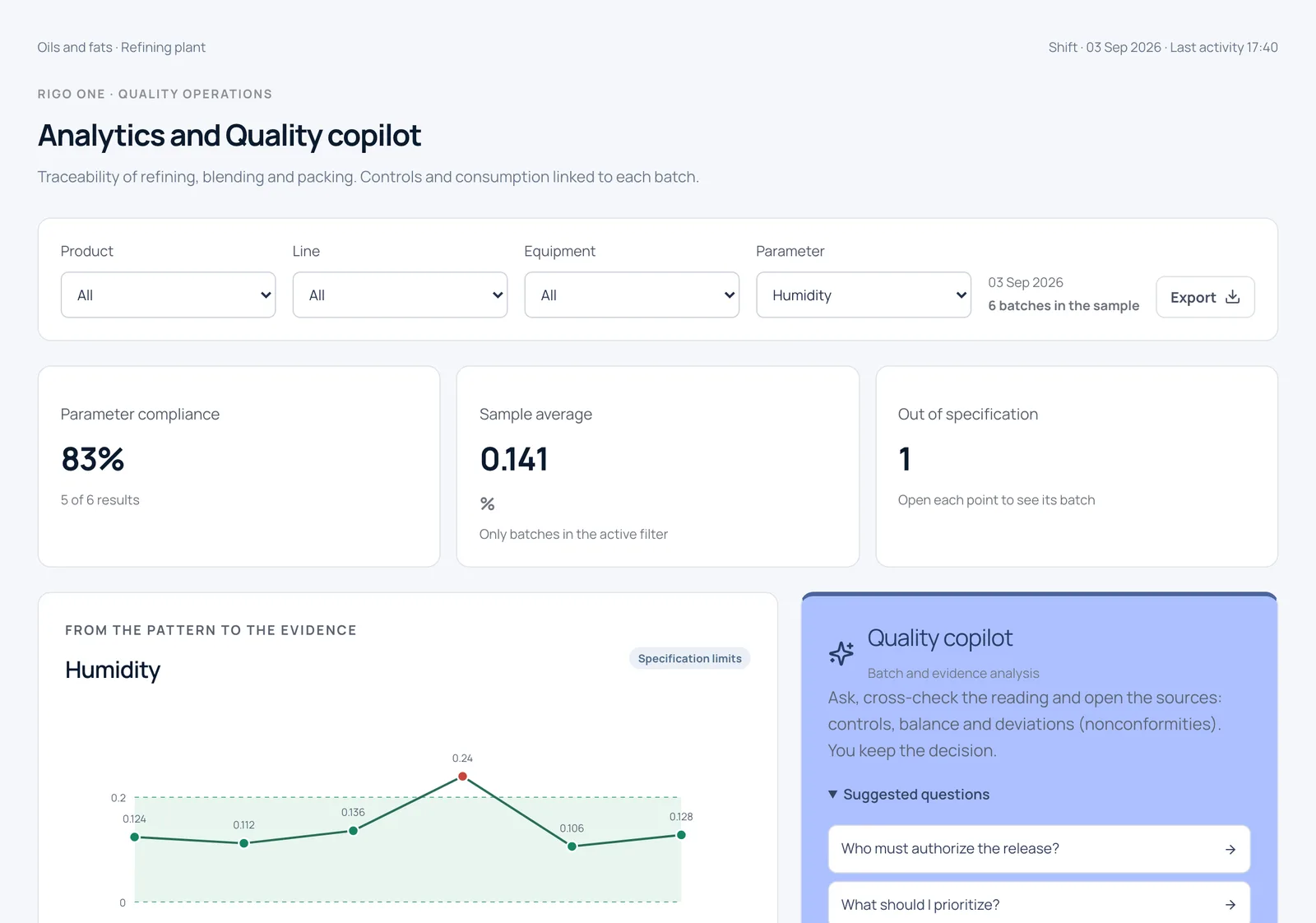
ANALYTICS WITH SOURCES
Filters by product, line and parameter, comparison across lines and export. Every figure lets you open the batch behind it.
FIVE PERSPECTIVES, ONE BATCH RECORD
Adding a record, approving it and authorizing the release are distinct actions belonging to distinct roles. A documentary approval does not erase an out-of-specification result.
See what is on hold, why, and how much volume depends on resolving it.
Prioritizes by risk and pending volume.Confirm that the requirements are covered before authorizing preparation.
Verifies the requirements and authorizes preparation.Add results and records, and correct a measurement without erasing the previous one.
Submits records or corrects a measurement.Approve or return a batch record, stating in writing what was missing.
Approves the evidence or returns it with an observation.Decide the release with the complete set in view, and leave a record of it.
Records the release decision.Preparation and review advance in parallel. The workflow configuration defines when the mass balance is required and who authorizes the release; publishing a new version of that configuration does not modify batch records closed under the previous one. In the demo you switch perspective freely to walk through the roles; role-based authentication and electronic signature are part of the pilot scope.
INDUSTRY PROFILES
The demo ships with 10 configured profiles. Products, stages, controls and documents change; the rule that decides the release is always the same.
Reception · Refining · Blending · Packing · Release
Humidity · Acidity · TemperatureWeighing · Dispersion · Adjustment · Filling · Release
Viscosity · pH · DensityResin reception · Preparation · Molding · Inspection · Release
Weight · Thickness · Leaks detectedDosing · Mixing · Baking · Packing · Release
Final moisture · Pack weightCarcass reception · Deboning · Conditioning · Derivatives processing · Packing · Dispatch
Carcass temperature at reception · Deboning room temperature · Meat pH · Derivatives cooking temperatureDosing · Extrusion · Drying · Bagging · Release
Pellet moisture · Pellet durabilityReception · Transformation · Separation · Packing · Release
Final moisture · Declared proteinReception · Grading · Packaging · Cold storage · Release
Grading defects · Net box weightWeighing · Mixing · Homogenization · Transfer · Quality review
Viscosity · pHYour operation is not listed? The generic core profile covers receiving, transformation, control and release, and is the starting point to configure your own.
RIGO ONE IN ACTION
From a pending record to an authorized release.
This is how the operation connects.
Demo with fictitious data. Decisions remain in the hands of authorized people.
TRY IT YOURSELF
Enter the demo and choose what you want to solve. You can pause, resume, restart or explore on your own. All with fictitious data.
Spot the missing record, submit it, approve it and authorize the release, moving through each perspective.
Investigate an out-of-range result, record the correction, reconcile the process loss and verify the closure.
Reconstruct the batch history, review the evidence and download the complete batch record.
Ask the copilot for the batches that share a raw material, a piece of equipment or a line, or that have a parameter above a threshold, and open the batches it returns.
Compare the same batch against two customer specifications, review the version in force and its history, and apply a concession from the catalogue of accepted exceptions.
Short sign-up. Nothing to install.
REGULATORY FRAMING
Rigo One organizes batch evidence the way quality and food safety management standards ask for it; it does not replace your management system and does not certify anything by itself.
Identification and traceability: every batch keeps its material genealogy, its stages and its linked records.
Control of nonconforming outputs: an out-of-specification result or an open deviation (nonconformity) blocks the release even when the batch record is complete.
Nonconformity and corrective action: investigation, containment, correction and verification are recorded as distinct steps, each with an owner and a rationale.
Backward and forward traceability by raw material batch, and the complete history that a mock recall requires.
21 CFR Part 11 (FDA) and Annex 11 of the EU GMP ask for the same thing underneath: knowing who did what, when and on what grounds, over data that cannot be altered without leaving a trace. Rigo One is built for that path, and the regulatory scope is settled during the pilot.
| Requirement | In the demo | In the pilot |
|---|---|---|
| Audit trail: who, what, when and on what grounds | Every transition keeps author, time, rationale and the version of the workflow configuration. | Server-side timestamp and an immutable record. |
| Role-based access control | Five perspectives with actions exclusive to each role: a documentary approval does not release. | Corporate authentication with the roles of your organization. |
| Electronic signature | Not included. | To be defined according to the agreed regulatory scope. |
| Data integrity (ALCOA+) | A correction keeps the original measurement and is recorded as a correction. | Input validation and environment backup. |
| Change control | The workflow configuration is versioned, and every batch keeps the version it was decided under. | Versioned specifications with formal approval. |
| Computerized systems validation | Not included. | Validation plan agreed with the client. |
Rigo One does not certify anything by itself: certification depends on your management system. What it brings is the path towards compliant electronic records, with the regulatory scope, root cause analysis and effectiveness verification of the CAPA cycle defined when the pilot is planned.
TRANSPARENCY
The demonstration is a working prototype with fictitious data. We would rather state precisely where the limit is.
Scope, integrations and the implementation plan are defined during the evaluation. See the full product sheet.
HOW TO EVALUATE IT
Three steps with defined scope and duration. Your operation does not stop, and from day one you know what you are going to measure.
We interview Quality, Production and the Laboratory, review real batch records and define how the data will come in: recorded in Rigo One, imported from your spreadsheets or your ERP, or through connectors. This is where we take the baseline figures for the four indicators — release time, volume on hold, review hours and cost of poor quality — and deliver a scope report with the success criteria.
One plant, one or two lines, your real batches. The operation carries on unchanged; Rigo One runs alongside it with your roles and your controls. The pilot is paid in two halves: the second only if the capability criteria agreed during discovery are met. We close with a results report against those criteria.
A dedicated environment for your company in the LILAB cloud, with support and updates included and unlimited users per plant. The pilot fee is credited in full towards the first-year license; the tiers and the add-ons are in the pricing table.
The data of each client lives in an isolated environment and can be exported in full at any time. The amounts, the add-ons and what every license includes are in the pricing table.
PRICING
No per-seat licenses and no surprises: one monthly amount per plant, billed annually, and a pilot split in two halves: the second is only paid if we deliver what we agreed on. A single screen of the demo shows 11,440 dollars on hold waiting for a decision; the license pays for itself as soon as one batch stops waiting a few days a month.
One plant, up to two lines, your real batches running alongside your operation. Everything paid is credited in full to the first-year license. If the criteria are not met, the second half is not charged and each side goes its own way.
To start with the line where the waiting hurts most.
The usual step for a mid-sized plant with several lines and a single Quality team.
The pilot runs in parallel: your operation keeps releasing with its current process, which is why we measure demonstrated capability rather than the impact on your release time yet. That impact is measured during the license.
Halfway through the first year we review the business-case indicators together — release time, volume on hold and review hours — against the baseline taken during discovery, and agree on what to adjust for the following six months.
Prices in US dollars, before taxes. Billed annually.
Rigo One is not an ISO document manager. It runs the release of every batch: controls against specification, evidence, mass balance, deviations and the decision with an owner. That is why it is charged per plant and not per user: the whole plant works on the same batch record.
GET TO KNOW RIGO ONE
For quality, production and review teams, and for the people who authorize release in industrial operations that work in batches and need to coordinate controls, evidence and decisions.
Operations that manufacture in batches or discrete orders and need traceability between raw materials, process, controls and finished product. The demonstration includes ten profiles: oils and fats, paints and coatings, biscuits and baked goods, meat deboning and derivatives, aquaculture feed, animal nutrition ingredients, fresh fruit and packing, semi-solid bulk pharmaceuticals, plastic packaging and a configurable generic core.
Five guided tours with fictitious data: unblocking a batch by completing its evidence, resolving a deviation, preparing an audit by reviewing the history and the batch record, finding a pattern by asking the copilot, and releasing for a customer by comparing the batch against two specifications. You can pause, resume and restart each guided tour.
Nothing to install: it runs in the browser and registration takes less than a minute. Each guided tour lasts between three and eight minutes, and you can explore on your own without following any of them.
The guided tour lets you investigate an out-of-range result, record the correction, review the balance and verify the closure. Closing the deviation does not automatically authorize the release: that decision belongs to the authorized approver.
Not yet. The demonstration works with fictitious data and is not connected to production systems. Integrations are part of the scope defined when a pilot is planned, and they are best reviewed in the discovery conversation.
Rigo One organizes quality and food safety evidence the way ISO 9001 and FSSC 22000 ask for it: identification and traceability by batch, control of nonconforming outputs, and recording of nonconformities with their corrective action. Against 21 CFR Part 11 and Annex 11 of the EU GMP, the demo already covers the audit trail with author, time and grounds, the separation of actions by role, keeping the original measurement when a value is corrected, and a versioned workflow configuration; corporate authentication, electronic signature and computerized systems validation are defined within the pilot scope. No software certifies anything by itself: certification depends on your management system.
Questions about the batches loaded in the demo: which ones share a raw material, which ones went through a given piece of equipment or line, or which ones have a parameter above a threshold. Every answer shows the batches behind it, and you can open them to check it. It is not connected to an external model by default, nor to real data, and it does not decide for anyone: it points to where to look.
In the demo, yes: the same batch is compared against two customer specifications, and you can see which one it conforms to and which one it does not. Every specification keeps its versions with the date, the reason for the change and who published it, and accepted concessions sit in a catalogue with their reference and validity. Formal approval by your own customer and the electronic signature are defined within the pilot scope; the internal release rule does not change.
Yes. The demo lets you attach up to three files per action, of up to 5 MB each: PDF, PNG, JPG, Word, Excel, CSV or TXT. The files are linked to your registration session and are not accessible to other visitors. Use test files only.
It is used to enable your access to the demo and to respond to your interest in the product. It is not sold or transferred for commercial purposes. You can request its review or deletion by writing to hola@lilab.io. The details are in the Privacy policy.
No. The batches and the guided tours use fictitious data. The actions of the exercise are saved in this browser; restarting a guided tour does not delete the attachments already saved. Decisions stay in the hands of the authorized people.
Rigo One is a product of LILAB S.A.C., a technology company based in Lima, Perú that designs custom software, digital products and automation for industrial and service operations.
It starts with a two-week discovery to map your release workflow, your controls and where the data will come from, and that is where we set the capability criteria. A two-week pilot follows, running in parallel with your operation, with one plant and one or two lines. One month in total, from signature to decision. The pilot is paid in two halves of USD 2,900: the first up front and the second at closing, only if the criteria are met. Everything paid is credited in full towards the annual license, which is charged per plant with unlimited users.
The second half is not charged. What was paid up front covers the two weeks of discovery and the two weeks of pilot support; if you decide to continue later, it is credited in full towards the license all the same.
The discovery together with the pilot, one month in total, costs USD 2,900 up front and USD 2,900 at closing, conditioned on meeting the agreed capability criteria; everything paid is credited in full towards the first-year license. After that, the license is charged per plant and billed annually: from USD 990 per month for one production line, and USD 1,490 per month for up to three lines, always with unlimited users, with a joint results review at six months against the discovery baseline. Additional plants of the same company get a 30 % discount, and connectors with ERP, LIMS or instruments are quoted per system. Prices are in US dollars and do not include taxes.
Rigo One is not an ISO document manager: it runs the release of every batch with its controls against specification, its evidence, its mass balance, its deviations and the decision with an owner. For that to work, Quality, Production, the Laboratory and whoever authorizes all work on the same batch record, so charging per seat would penalize exactly what makes the product useful. That is why the price is per plant and users are unlimited.
You can explore the demo through a simple registration, or schedule a discovery conversation with someone from the team. In that meeting we review the workflows, the control points and the needs of your operation. After that conversation, the standard path is a two-week discovery and a two-week pilot running in parallel with your operation.
LET US START WITH YOUR OPERATION
Let us talk about your flows, your control points and the information your team needs to decide. Let us find where Rigo One can help.
Pick the time that works best for you.